Sunday, October 13, 2013

How does public support impact the effectiveness of a presidency?-THOMAS JEFFERSON


Portrait of Thomas Jefferson by Rembrandt Peale.
           Public support is the process of being able to gather  voluntary contributions or other resources,  from individuals. It is soley based on the Public's opinion and is made up of an individuals attitude and beliefs. Public opinion can also be defined as the collection of opinions from many different people and can also be the sum of all their views, or as a single opinion held by an individual about a social or political topic. If does not agree with certain views they will not follow a leaders way.

            In his first term Jefferson was attacked on his personal character that have rarely matched in presidential history. In 1802 charges against him were publicized by James Thomson Callender, a journalist who he had befriended. He turned on him when not given a  federal appointment. These charges were taken up by Jefferson's political enemies, but he maintained his policy of making no public reply to personal attacks. The abuse he suffered from newspapers weakened his confidence in a free press. He believed that his reelection in 1804 justified his toleration of his critics.
              From an early stage in his public career, Jefferson had been subjected to attacks on religious grounds. He kept his opinions regarding religion very much to himself, he thought they were a private concern, his insistence on the complete separation of church and state was well known. That helped him gain the support of  dissenting groups, the Baptists, but it aroused bitter opposition among Congregationalists in those parts of New England where the clergy and constituted a virtual establishment. Overall, we can see that public supports affects any individual in a goal they are trying to accomplish.

Saturday, October 5, 2013

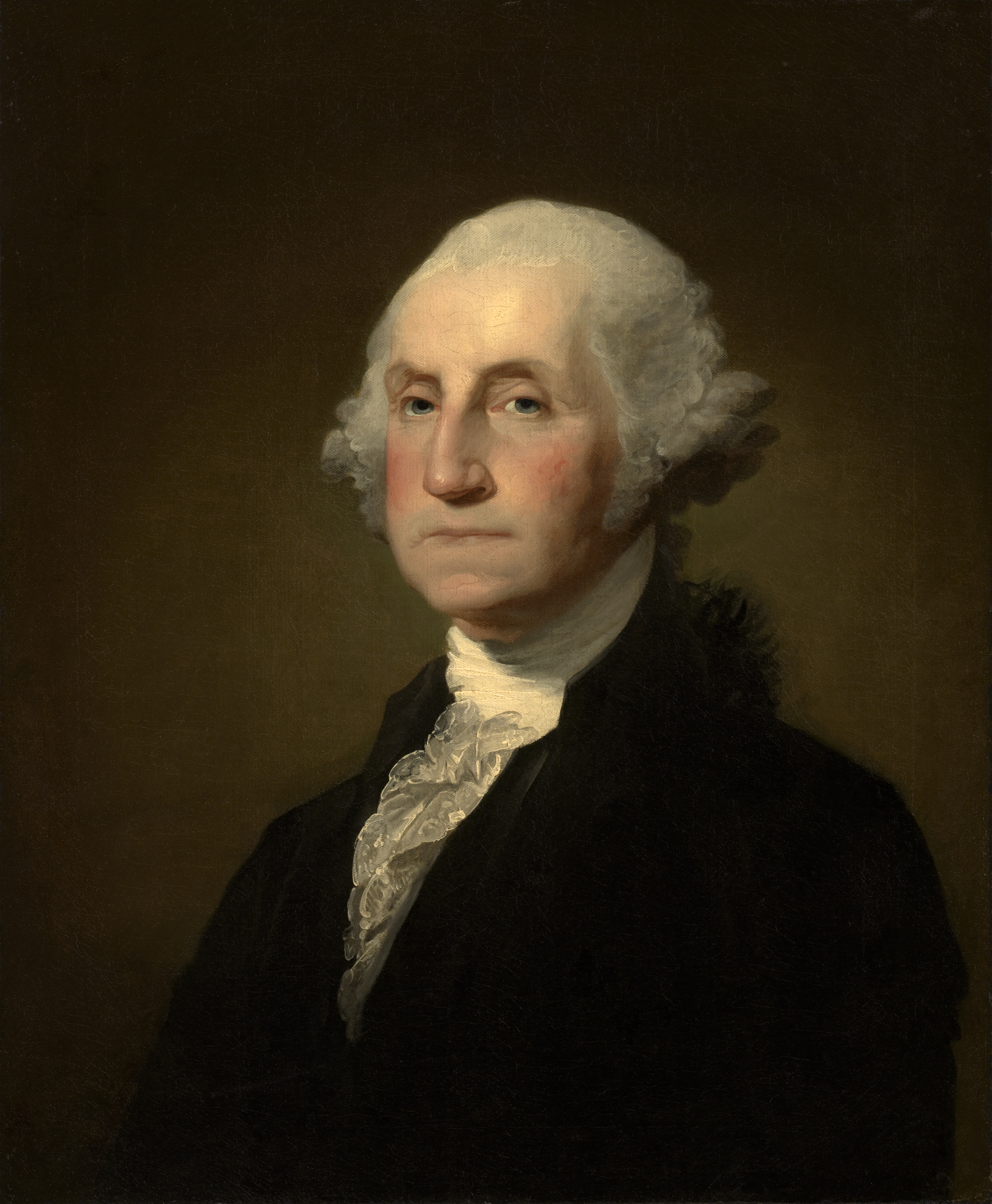
George Washington, Before Presidency

George Washington was born on February 22, 1732, in Virginia. Washington served as a general and chief of the colonial armies during the American Revolution, and later became the first president of the United States. He died on December 14, 1799, in Mount Vernon, Virginia. In 1748, when he was 16, George traveled with a surveying party plotting land in Virginia’s western territory. 
Wife Martha and kids
with George Washington
Washington was given the honorary rank of colonel and was asked to join British General Edward Braddock's army in Virginia in 1755. Though he fought bravely, he could do little and therefore led the army back to safety. In August, 1755, Washington was made commander of all Virginia troops at age 23. A month after leaving the army, Washington married Martha Custis, a widow, who was only a few months older. She brought to the marriage a fortune and with that and land he was granted for his military service, Washington became one of the wealthy landowners in Virginia. Martha's also brought to the marriage two young children, John and Martha.
George Washington&slaves
Retiring from the Virginia militia until the start of the Revolution, George Washington devoted himself to the care and development of his land holdings. He worked six days a week, often taking off his belongings and performing manual labor with his workers.  He kept over 100 slaves, and was said to dislike the institution, but accepted the fact that slavery was the law. He entered politics and was elected to Virginia's House of Burgesses in 1758.

Friday, September 13, 2013

PONTIAC'S REBELLION


Pontiac's Rebellion resulted from the French and Indian War and was another major factor leading to the American Revolution.The Pontiac Rebellion began with the Native American Confederacy warriors who were controlled by the Ottowa chief, Pontiac, who attacked the British forts in Detroit. Pontiac began receiving support from all Indians tribes in order to launch a campaign against the British in their French lands. Pontiac had a plan in which tribes would have a designated fort and would seize them before joining together to seize the others.
On July 31, a British relief expedition attacked Pontiac's camp but suffered heavy losses and were repelled in the Battle of Bloody Run. They succeeded in providing the fort at Detroit with reinforcements and supplies. However, the united tribes captured eight other fortified posts. In 1764, two British armies were sent out, one into Pennsylvania and Ohio under Colonel Bouquet, and the other to the Great Lakes under Colonel John Bradstreet. Bouquet's campaign met with success, and the Delawares and the Shawnees were forced to sue for peace, breaking Pontiac's alliance.
Failing to persuade tribes in the West to join his rebellion, and lacking the hoped-for support from the French, Pontiac finally signed a treaty with the British in 1766. In 1769, he was murdered by a Peoria Indian while visiting Illinois. His death led to bitter warfare among the tribes, and the Peoria's were nearly wiped out. Because the Indians took over British forts and took over settlements King George III wanted to end it by issuing the Proclamation of 1763, which led the British to become extremely angry. It also led to the American Revolution which was a conflict that arose between the residents of the American colonies and the colonial government because the British wanted to be in control.


Friday, August 30, 2013

Virginia Company-Jamestown


Royal Colony
Important People: King James I, Captain John Smith
Places; Chesapeake Bay
Indian Population: 50,000 Virginia Indians (30 tribes)25,000 Powhatan Indians before the foreigners arrived decreased to 15,000 right after they settled
Captain John Smith formed good relationships with the natives
Year settled May 14, 1607
Important Events: The Arrival of Africans-1619 became indentured servants.
religion: Spreading Christianity
Ruling England: King James I


     In June of 1606, King James I sent the Virginia Company, to establish an English settlement in the Chesapeake region. In December, 104 settlers sailed from London and were told to settle in Virginia. Their goal was to find gold, and seek a water route to the Orient. On May 14, 1607, the Virginia Company explorers landed on Jamestown to establish the Virginia colony on the James River. After landing, the colonists were attacked from their enemy, the Algonquian natives. As a result, within a month the settlers managed to build a wooden fort; its walls formed a triangle around a storehouse, church, and a number of houses. 

 The Powhatan Indian trade revived the colony with food in exchange for glass beads, copper, and iron implements. The structured leadership of Captain John Smith kept the colony from dissolving. The "Starving Time" winter followed Smith's departure in 1609 during which only 60 of the original 214 settlers at Jamestown survived. The arrival of Africans was also a crucial event that would play a role in the development of America to Jamestown. A Dutch slave trader exchanged his cargo of Africans for food in 1619. The Africans became indentured servants, similar to many poor Englishmen who traded several years of labor in exchange for passage to America.
     The Algonquians eventually felt let down and, in 1622, attacked the plantations killing over 300 of the settlers. Even though a warning spared Jamestown, the attack on the colony and mismanagement of the Virginia Company convinced the King that he should revoke the Virginia Company Charter. Therefore, Virginia became a crown colony in 1624. 

Thursday, August 15, 2013

Ferdinand Magellan


          Magellan was born in Northern Portugal. His parents, Pedro Ruy de Magalhaes and Alda de Mezquita, were very wealthy and powerful. Magellan sailed to India and to the Far East many times through Africa's Cape of Good Hope. He sailed for Portugal, but a disagreement with the Portuguese King Manoel II led him to turn against the Portuguese. Therefore, he decided to sail for Spain
          Magellan and his companion, Ruy de Falero, explained to King Charles V,of Spain, that a westward voyage around the top of South America would lead them to the Moluccas, an island filled with riches. They would then avoid the Portuguese to avoiding confrontation. Their voyage began September 8, 1519, which lasted until September 6, 1522. Magellan sailed from Seville, Spain, with five ships, the Trinidad, San Antonio, Concepcion, Victoria, and Santiago.Three years later, only the ship the Victoria made it back to Seville, carrying only 18 of the original 270 crew members.
          Magellan was killed towards the end of the voyage, on the Island in the Philippines, during a battle with the natives. The Basque navigator Juan Sebastián de Elcano completed the trip.In his trip, He headed southwest down toward South America. Staying along the East coastline of South America, then sailing through a waterway at the southern tip of South America, known as the Strait of Magellan. He then started heading North toward Hawaii then going downward to the West and landing in the Philippines. He dies in the Philippines, but one of his ships ,the Victoria, travels all the way back to Spain with aboard 18 men, who were the first Europeans to navigate the entire world.